
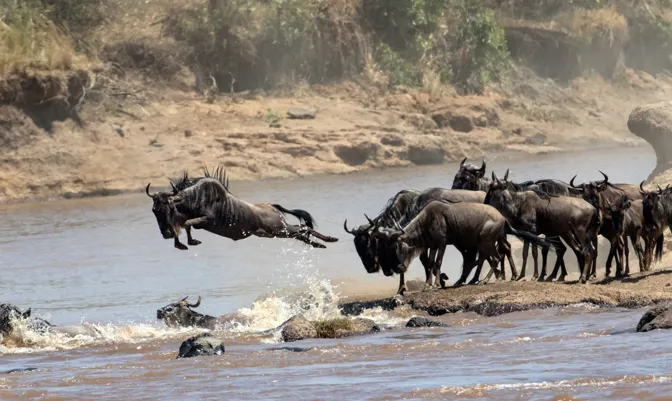


H3_W3_008
Date: 2016
Location: Masai Mara, Kenya
Did you know?
The name, Wildebeest, is Dutch for ‘wild beast’ or ‘wild cattle’ in Afrikaans. They are technically part of the Antelope family. Wildebeest inhabit the plains and open woodlands of parts of Africa south of the Sahara. Each year, some East African populations of Blue Wildebeest have a long-distance migration, seemingly timed to coincide with the annual pattern of rainfall and grass growth. Aerial photography has revealed that a level of organisation occurs in the movement of the herd; for example, the migratory herd exhibits a wavy front, and this suggests that some degree of local decision-making is taking place.
About the picture
This photo was taken during the Great Migration of 2016 in Masai Mara. A herd of Wildebeest and Zebra were trying to cross the Mara River. To avoid the hungry Nile crocodiles that swarmed the river, some of the Wildebeest chose to leap high into the water and get to the other side. I was lucky enough to experience this and also click a picture.
Fun Fact
Apart from the Blue Wildebeest, there is another subspecies – the Black Wildebeest – found in Africa. The Black Wildebeest has forward-facing horns, a black or darker coat, and a white tail similar to that of a horse.